From translation to orchestration: the LangOps revolution
Here’s the challenge facing global organizations today: AI can churn out translations and generate content at speeds we’ve never seen before. But who’s actually making sure this content maintains quality, stays consistent, and resonates culturally across dozens of languages? That’s where LangOps and content architecture – comes into play.
First brought to the forefront by industry visionaries such as João Graça in his groundbreaking Forbes article in April 2021, LangOps represents a paradigm shift from reactive translation workflows to proactive, scalable solutions.
The traditional approach – where marketing hires freelancers, sales recruits native speakers, and product manages localization separately – creates costly silos. In the 2021 Unbabel LangOps Survey, nearly a quarter of global business decision makers ranked language and cultural differences among their top five growth blockers.
Why Content Architecture matters more than ever
Let’s be clear about something: throwing AI at messy content won’t fix your problems. If anything, it’ll expose just how disorganized your content operations really are. We’re already seeing this play out – companies rush to implement AI solutions, only to realize their content is too unstructured for the technology to work properly.
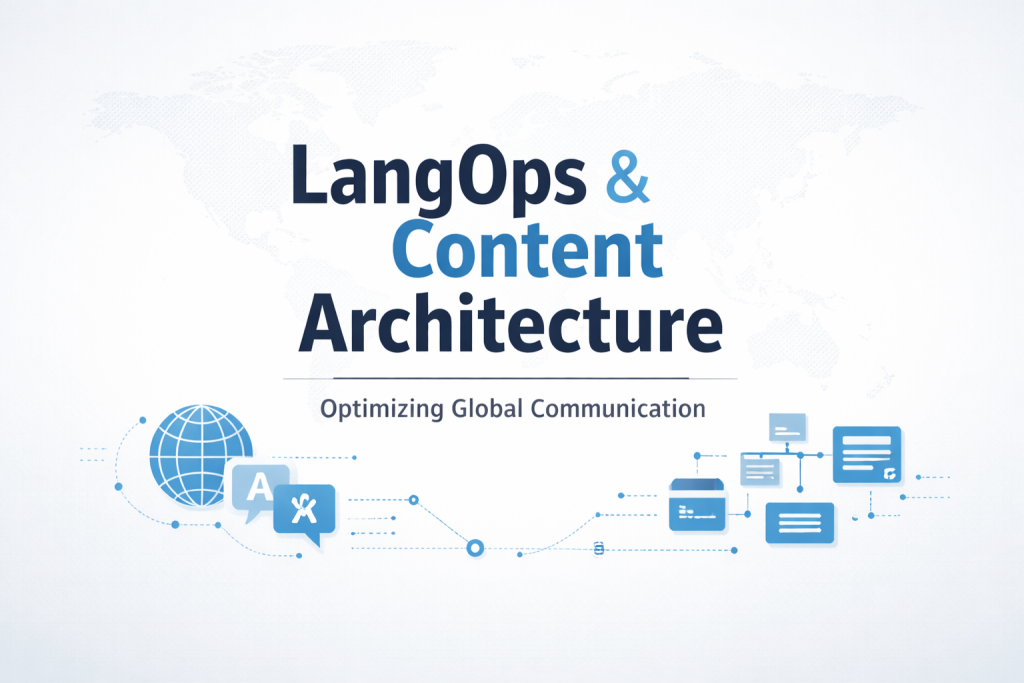
This is exactly why content architecture has become so crucial. The organizations winning in 2026 aren’t necessarily the ones who adopted AI first. They’re the ones who took time to build proper governance frameworks, establish clear workflows, and create content systems that can actually scale.
What does good content architecture look like ?
- Design with reusability in mind. Content should flow smoothly from creation through translation and then out to various markets, without requiring constant reinvention,
- Use controlled language principles. Frameworks like Simplified Technical English aren’t just about simplification—they make content easier for both humans and machines to translate accurately while cutting cost,
- Build solid governance systems. You need clear terminology databases, comprehensive style guides, and quality frameworks that can grow alongside your AI tools,
- Optimize for retrieval. Whether it’s human users or AI agents accessing your content, they need information architectures that make sense across different cultural contexts.
The three pillars holding up modern LangOps
While tools and platforms matter, effective LangOps really depends on three foundational elements:
1. Breaking down silos through integration
Localization can’t live in its own bubble anymore. When it’s genuinely integrated across marketing, product development, sales, and customer support, things run smoother. This means shared workflows, dashboards everyone can access, and clearly defined roles. No more departments operating like isolated islands.
2. Finding the right balance between humans and AI
Here’s the thing about AI: it handles volume and speed brilliantly, but it still needs human oversight for nuance and quality control. Smart LangOps workflows combine machine translation with human post-editing, use AI for quality estimation, and route content to the right linguists based on type and priority. It’s about strategic deployment of both resources.
3. Managing data strategically
By now, Retrieval-Augmented Generation (RAG) has become standard practice – about as remarkable as ETL processes for moving data around. But truly effective LangOps goes deeper than just implementing the latest tech. You need robust knowledge graphs, industry-specific terminology databases, and quality frameworks that feed AI systems reliable, culturally appropriate information.
What multilingual strategy actually looks like
When companies get multilingual content strategy right, you’ll notice they prioritize several key areas :
- Cultural adaptation wins over literal translation. Consumers respond far better when content genuinely feels like it was created for their culture, not just converted word-for-word from English.
- SEO strategies need local context. What people search for in France differs from search patterns in Japan or Brazil. This requires dedicated keyword research and metadata optimization for each market.
- Eliminate friction wherever possible. Whether it’s emotional friction, cognitive overload, or clunky interactions, these pain points kill conversions. Too many brands create frustrating experiences for audiences outside their primary market.
Who’s managing all this complexity?
The professionals handling these responsibilities go by different titles – Localization Manager, Content Operations Director, Global Content Architect – but they share similar skill sets:
They think strategically about content investment and how to structure global information systems. They’re technically proficient with translation management platforms and AI tools. They understand language deeply but also grasp the technology powering modern translation. They can manage distributed teams across time zones and cultures. And they bring cultural awareness that prevents costly mistakes.
What’s Coming in 2026
Prompt engineering? That’s already being absorbed into broader roles and tool suites. Hallucinations in AI output ? Companies still track them, but they’re no longer stopping enterprises from deploying AI systems. The conversation has shifted from “Should we use AI?” to “How do we make this work at scale?”
The experimentation phase is ending. What’s replacing it is a focus on operational excellence and sustainable implementation.
Language as strategic infrastructure
This is the fundamental shift happening in 2026: language operations are moving upstream in business processes. Instead of treating localization as something that happens after everything else is decided, forward-thinking companies are building it into their core operations from the start.
Language isn’t a barrier anymore – it’s infrastructure. It’s strategic. It enables global success rather than limiting it.
Interested in preparing for a career in language operations? Programs like the TCLoc Master at the University of Strasbourg bring together technical communication, localization strategy, and emerging technologies. It’s designed for professionals who want to work at the intersection of content, language, and technology – exactly where the industry is heading. Learn more about the program and see if it matches your career goals.