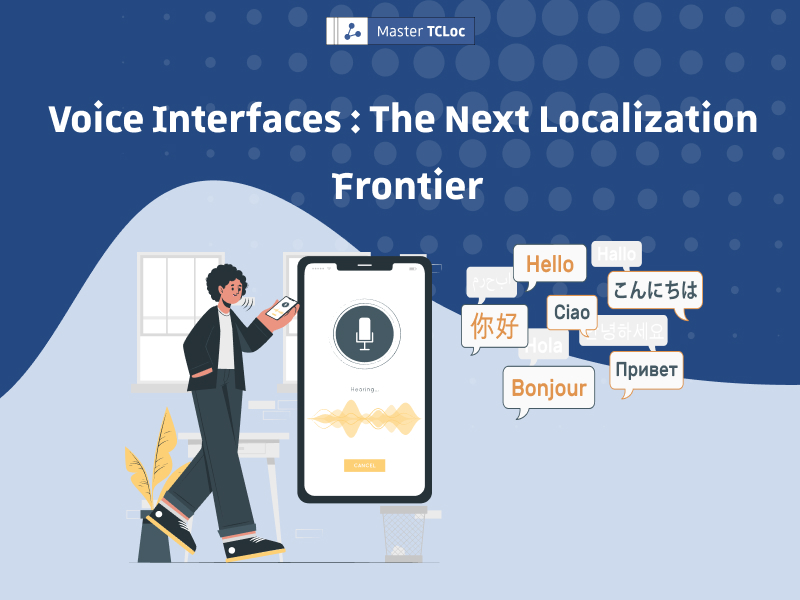
Ask Siri for directions in a Senegalese accent. Try telling Alexa to “play something relaxing” in Quebecois French. Chances are, you will be met with a polite failure or worse, a confidently wrong answer. Voice assistants and AI voice agents are spreading across the globe at an extraordinary pace, yet the industry’s approach to voice interface localization still lags years behind the methods we apply to traditional visual software. That gap is not a minor inconvenience; it is a fundamental failure of design that overlooks the nuances of dialect and delivery.
Localising a graphic user interface (GUI) is, by now, a well-understood discipline. Translators, engineers, and UX designers have spent decades refining workflows for buttons, menus, and error messages. The voice user interface (VUI), however, operates under an entirely different set of rules that the industry has only begun to map. As we’ve explored in our previous discussion on why localization errors are often content errors, not translation errors, the challenge is structural. To succeed globally, voice interface localization must go beyond literal translation and integrate cultural conversational norms, acoustic nuances, and voice-specific UX design from the very first sprint.
GUI vs. VUI: Why Traditional Translation Fails
The Illusion of “Written” Speech
Text on a screen is permanent. A user can scan it, re-read it, and scroll back to it. Speech is transient and linear: once the AI has spoken a sentence, it is gone. This seemingly obvious difference has enormous implications for localization.

Consider a three-sentence error message. On a screen, it works perfectly. The user reads at their own pace, parses the structure, and acts accordingly.
However, imagine a voice agent speaking that same message at 150 words per minute. It quickly becomes a wall of sound. This piles cognitive load onto the listener before they can even process the error. Translating the text accurately is the easy part. The real frontier is mastering voice interface localization by restructuring content for the ear in every target language.
Text Expansion in the Auditory Realm: A Voice Interface Localization Challenge
Localization engineers are deeply familiar with text expansion: a 40-character English string can balloon to 55 characters in German, breaking a carefully designed UI layout. In VUI, expansion does not break a pixel grid it breaks the timing and rhythm of a conversation. A response engineered to feel brisk and natural in US English may sound rushed or incomplete in Brazilian Portuguese, where the equivalent phrasing naturally runs longer. The AI does not just sound unnatural; it sounds impatient, even rude. Solving this requires rethinking the content itself, not merely its translation.